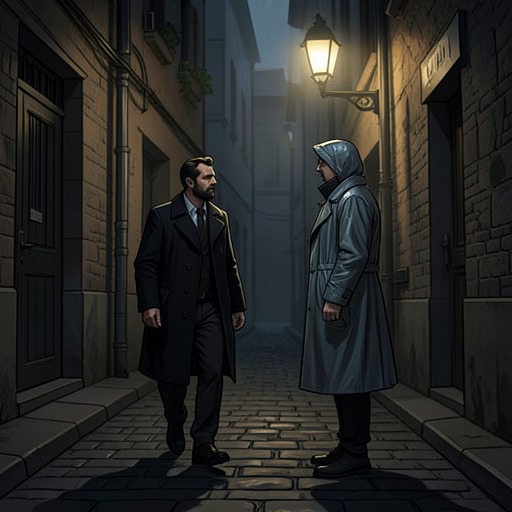
Jake confronts the school custodian
I'm Thinking of Ending ThingsJake’s confrontation with the school custodian begins as a rupture inside the car: convinced that the man has been leering at them, Jake will not leave the Rural High School without speaking to him. His trembling anger turns the narrator’s attempt to withdraw into a conflict over whether to act, and ends with Jake leaving the car alone in a snowstorm. The confrontation is set in motion, but the scene stops before the encounter itself takes place.
The Accusation and Its Limits
Jake frames the man’s behavior as more than an uncomfortable look. He calls it perverse and insists that the man had been doing something and liked watching them. His certainty rests on what he says he saw: a wave or movement of the man’s hand, described as wave-like. Yet the narrator’s question about how Jake knows exposes an important limit in the scene. The accusation is Jake’s interpretation; the narrator does not confirm seeing the gesture or establish what the man intended.
Jake first says that he knows the man, then qualifies the claim: he knows the man, or men like him. That correction leaves the basis of his recognition unresolved. It does not lessen his conviction that the behavior was wrong, but it makes clear that the certainty driving him exceeds what the scene independently verifies. The distinction between an observed movement and the meaning Jake assigns to it becomes the point from which the rest of the episode escalates.
Refusal to Leave
The narrator tries to end the encounter by asking Jake to go, at first directly and then with repeated pleas. Jake answers that he cannot ignore what he has seen and insists on giving the man a hard time. The disagreement is therefore not simply over whether the narrator believes the accusation. The immediate conflict is over what should happen next: the narrator wants them to leave, while Jake treats departure without speaking to the man as an unacceptable response.
The narrator’s physical gestures underline that wish to stop the escalation. The narrator puts both hands over their face and closes their eyes, then reaches across toward Jake. Jake shoves the reaching hand away. The narrator describes him shaking his head, being angry, and trembling in his hands; the narrator has never seen him behave this way before. These details make his agitation visible before it becomes action, while the narrator’s pleas register an effort to calm him and get him back from the brink of leaving the car.
The Decision to Get Out
Jake repeats that they are not leaving until he has spoken to the man. When he opens the car door, the narrator reaches for his right arm and warns him that there is a snowstorm, urging him to get back inside and abandon the confrontation. Jake responds by telling the narrator to wait. The narrator registers the instruction as a command rather than a suggestion, a change in the balance between them: he is no longer negotiating about whether to go, but directing the narrator to remain behind.
He slams the door without looking back and marches around the side of the school until he disappears from view. The narrator is left in the quiet, empty car and does not move for almost a minute. That pause gives the departure its immediate consequence: Jake’s decision separates the pair, leaving the narrator alone with the abruptness of his anger and the unanswered question of what will happen next. The storm, invoked by the narrator as a reason not to go out, becomes the condition under which Jake nevertheless leaves.
A Confrontation Deferred
The scene’s decisive action is Jake’s departure to confront the man, not a completed exchange with him. No conversation between Jake and the custodian is shown here, and the narrator cannot report what happens after Jake disappears around the building. Keeping the encounter offstage preserves the uncertainty at the center of the accusation: Jake is certain about what he saw and what the man meant, but the narrator and reader have not been given independent confirmation.
That gap also shapes the scene’s tension. The narrator’s account stays close to the immediate sequence of pleas, gestures, and movement: a hand is shoved away, a door opens, a warning about the storm goes unheeded, and Jake vanishes from sight. What begins as a dispute over an ambiguous gesture becomes an irreversible separation from the safety of the car, though its outcome remains unknown at this point. Jake’s insistence that he must act, set against the narrator’s insistence that they leave, makes the episode a turning point in the immediate encounter without resolving either the accusation or the confrontation it provokes.